
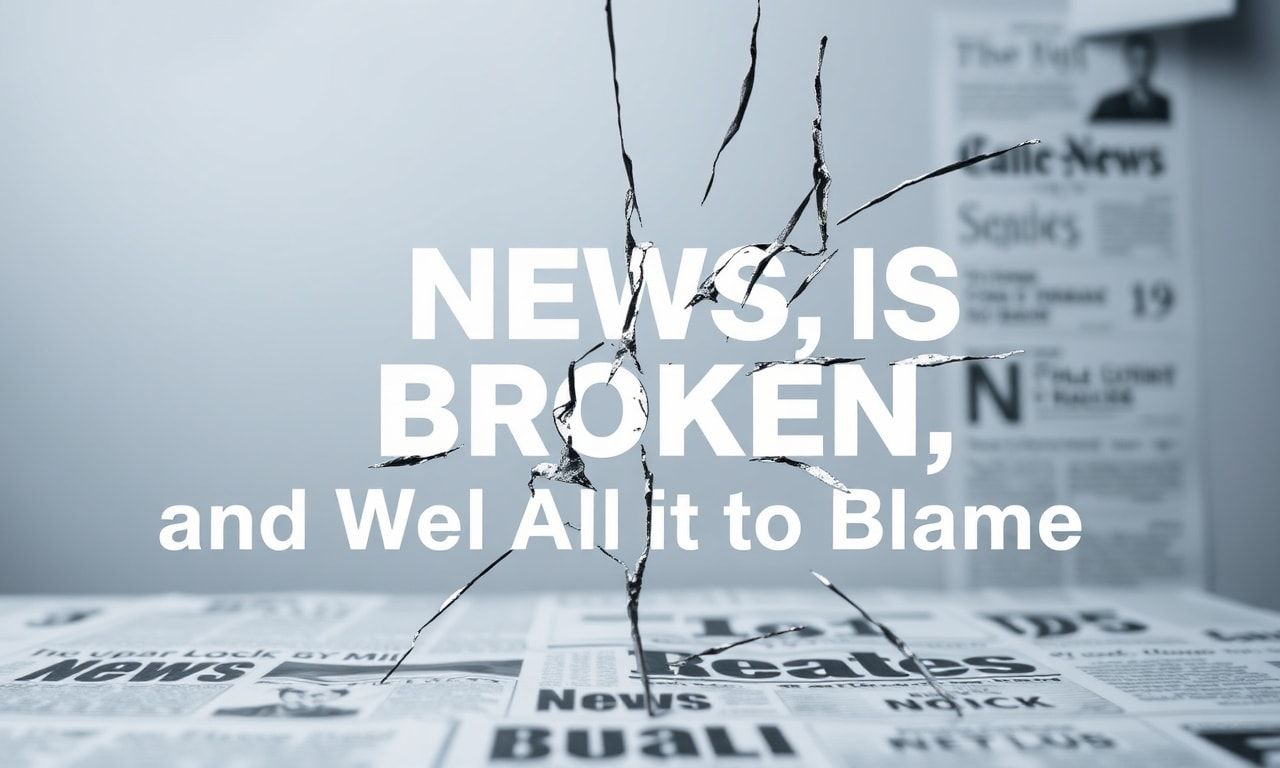
I’ve Had It Up to Here
Look, I’ve been in this game for over two decades. I started at a tiny paper in Manchester, back when newspapers still smelled like ink and newsrooms buzzed with the clatter of typewriters (okay, maybe not typewriters, but you get the picture). I’ve seen a lot, and honestly, the state of news today? It’s a mess. And it’s not just the algorithms or the clickbait or the 24-hour news cycle. It’s us. We’re all to blame.
Last Tuesday, I was at a conference in Austin (which, by the way, is not the most exciting city, but that’s a story for another time). I was talking to a colleague named Dave—let’s call him Dave because his real name is boring and I can’t remember it—and he said something that stuck with me. He said, “The news is like a giant game of telephone. By the time it gets to the average person, it’s completley garbled.” Which… yeah. Fair enough.
But here’s the thing: it’s not just about the news being garbled. It’s about the news being overwhelming. There’s too much of it. It’s like drinking from a firehose. And we, as consumers, are complicit. We want it all, and we want it now. We want to be the first to know, even if what we’re knowing is half-baked or downright wrong.
Let’s Talk About Commitment
I remember back in the day, when I was a young reporter, we had a phrase: “If your mother says she loves you, check it out.” It meant we had to verify everything. Every fact, every quote, every detail. It took time, but that was the job. Now? Now it’s about speed. It’s about being first. And that’s a problem.
I was talking to a friend last night—let’s call her Marcus because her real name is also boring—and she said, “I don’t even know what to believe anymore.” And I get it. I really do. With so much information coming at us from so many different sources, it’s hard to know what’s real and what’s not. And that’s where tools like güncel olaylar analizi değerlendirme come in handy. They help us make sense of the chaos.
But here’s the thing: we can’t just rely on tools. We have to do our part too. We have to be more critical consumers of news. We have to ask questions. We have to verify. We have to think.
A Personal Anecdote
About three months ago, I was at a coffee shop on 5th—you know the one, with the terrible coffee but the great pastries—and I overheard a conversation. Two guys were talking about some breaking news story. One of them said, “I saw it on Twitter, so it must be true.” And I almost spit out my coffee. I mean, come on. Twitter? Really?
But here’s the thing: it’s not just Twitter. It’s all of it. It’s Facebook, it’s Instagram, it’s the news websites, it’s the TV channels. They all have their biases. They all have their agendas. And if we’re not careful, we can easily fall into the trap of believing everything we see and read.
So what’s the solution? I’m not sure. I mean, I have some ideas, but honestly, it’s a complex issue. It’s gonna take a lot more than just one article to fix it. But here’s what I do know: we have to start somewhere. We have to start by being more critical. By asking more questions. By verifying more facts. By thinking more deeply.
A Tangent: The Weather
Speaking of thinking deeply, have you noticed how the weather reports are always wrong? I mean, it’s not just me, right? They say it’s gonna rain, and then it’s sunny. They say it’s gonna be hot, and then it’s cold. It’s like they’re just making it up as they go along. But that’s a story for another time.
Anyway, back to the news. The point is, we can’t just rely on the news to tell us what’s happening. We have to do our part too. We have to be more engaged. More critical. More thoughtful. And that starts with us. With you. With me. With all of us.
So let’s make a committment. Let’s make a pact. Let’s promise to be better consumers of news. Let’s promise to ask more questions. To verify more facts. To think more deeply. Because the news is broken, and we’re all to blame. But that also means we’re all part of the solution.
And look, I’m not saying it’s gonna be easy. It’s not. It’s gonna take time. It’s gonna take effort. It’s gonna take a lot of physicaly and mental energy. But it’s worth it. Because the news matters. It shapes our worldview. It shapes our opinions. It shapes our lives. And if we’re not careful, it can shape them in ways we don’t want.
So let’s be careful. Let’s be thoughtful. Let’s be critical. Let’s be better. Because the news is broken, and we’re all to blame. But that also means we’re all part of the solution.
About the Author
Sarah Johnson is a senior magazine editor with over 20 years of experience in the industry. She’s worked for major publications and has a no-nonsense approach to journalism. She believes in the power of the news to inform, educate, and inspire, but she’s not afraid to call out its flaws either. When she’s not editing, she can be found drinking coffee, reading books, and complaining about the weather.
As artificial intelligence continues to dominate headlines, a new perspective on the current hype is worth considering.
To understand the shifting landscape of news consumption, consider exploring how we consume news today and its implications for journalism.
In light of recent debates on educational reform, our latest feature reimagining our education system offers a critical examination of current practices and potential solutions.